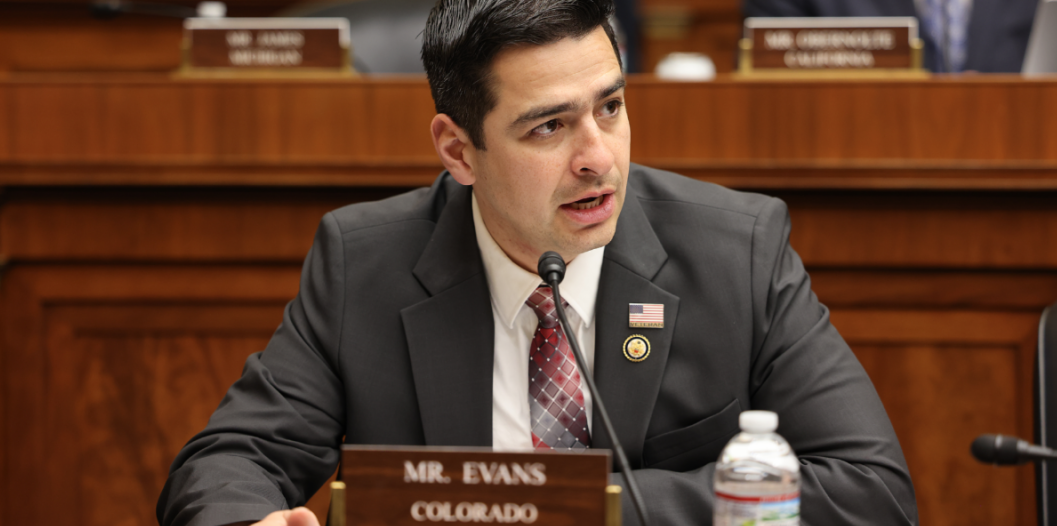
On August 3, Gabe Evans sent his constituents a newsletter about visiting the Five Rivers Kuner Feedlot in Weld County. There was a photo with the executives. There was a line about how "agriculture remains one of Colorado's greatest economic engines, and I'll continue fighting to keep it strong."
Six months earlier, on February 10, Evans had voted twice to keep the House of Representatives from voting on the tariffs driving up that feedlot's costs. Three Republicans broke ranks and killed the attempt. When the vote finally happened the next day, Evans voted against ending the tariffs.
The votes you can look up yourself
On February 10, 2026, Republican leadership put a provision at the end of a procedural rule, H.Res. 1042. Section 4 said that no day between February 10 and July 31, 2026 would count as a "calendar day" under the National Emergencies Act — the clock that forces the House to vote when a member moves to end one of Trump's tariff emergencies. It named four of them, including the February 1, 2025 emergency behind the tariffs on Canadian goods.
In plain terms, the rule would have switched off the House's obligation to vote on the tariffs until August.
Rep. Joe Neguse (D-CO) tried to strip it out. "If we defeat the previous question," he told the House, "I will offer an amendment to the rule to strike section 4, which would stop an attempt by Republican leadership to block the House from taking up-or-down votes on President Trump's disastrous tariff policies through the end of July."
The previous question is the parliamentary tool that shuts off any chance to amend a rule. It carried 216 to 214, according to the official House roll call. Two votes was the entire margin.
Gabe Evans voted yes.
Then Evans voted for the rule itself — and lost. It failed 214 to 217, because three Republicans refused to go along: Don Bacon of Nebraska, Kevin Kiley of California and Thomas Massie of Kentucky. Section 4 never took effect.
Minutes later, with the rule dead, Foreign Affairs Committee Chairman Brian Mast asked unanimous consent to make the tariff resolution in order at any time. There was no objection.
So the House got its vote. On February 11 it passed the resolution ending the emergency behind the Canadian tariffs, 219 to 211, with six Republicans voting for it.
Gabe Evans voted no.
Eight votes, one direction
The Colorado Times Recorder went through Evans' record and counted eight votes since he entered Congress that supported Trump's tariffs or blocked Congress from touching them:
- In February 2026, he voted against a symbolic resolution to end the national emergency used to justify tariffs on Canadian goods — a resolution that passed anyway, with six Republicans voting for it. Evans was not one of them.
- He was on the losing side of a February vote to delay a vote on cancelling the tariffs.
- He twice voted to block joint resolutions that would have terminated the tariffs.
- He cast the February 10 previous-question vote above.
- In 2025, he voted four times to stop Congress from challenging or even considering the tariffs.
Evans has never voted against a tariff measure, and has offered essentially no public criticism of the policy.
The businesses in the photos disagree with him
This is what makes the newsletters uncomfortable reading. Evans keeps showing up at businesses whose own leaders have said tariffs hurt them.
Queso Campesino, a cheese importer in his district, got a newsletter mention last year. Its owner, Gabriel Robles, told the Colorado Times Recorder at the time that Trump's tariffs were hurting his business — and that it made him question whether he'd support Republicans in the next election.
The Colorado Association of Home Builders got a June 16 newsletter, in which Evans wrote about making "the American Dream more attainable for Colorado families." Its national parent, the National Association of Home Builders, states flatly on its website that tariffs "act as a tax on American builders, home buyers, and consumers," and says more than 60% of builders it surveyed have reported higher costs because of them. NAHB wrote to Trump asking him not to raise tariffs on Canadian and Mexican building materials. He raised them anyway, more than once.
Leprino Foods in Greeley — the world's largest mozzarella producer — got two visits, in September 2025 and again on August 3. In 2022 congressional testimony, Leprino CEO Mike Durkin said the opposite of what Evans votes for:
"If we do not build our globally competitive market access now through reduced tariffs, competitive prices, and consistent shipping, our producers will be unable to grow. There is hardly a more critical priority for the U.S. dairy industry than trade."
The feedlot. Farmers, ranchers and feedlots have seen the price of fertilizer, machinery and feed pushed up by tariffs and by the uncertainty around them.
The pattern is the same every time: Evans arrives, poses, publishes a newsletter about fighting for them, and then votes to keep in place the policy they've said is hurting them.
"Absolutely confident"
In a telephone town hall with constituents last year, Evans was asked about the tariffs. His answer:
"It seems like everything's in flux, but at the end of the day, I am absolutely confident that by getting back to free and fair trade practices … that will ultimately bring down the prices of goods for all Americans."
That was the prediction. Here is the scoreboard since: about 100,000 American manufacturing jobs were lost during the first year of Trump's second term amid rising material costs and tariff uncertainty. Congressional Democrats estimate tariffs will cost the average American family $2,500 in 2026. Grocery prices have been widely blamed on them.
Evans' office did not respond to a message asking whether he still believes the tariffs will bring costs down.
Why this pattern matters in the 8th District
Paul Teske, a professor at the University of Colorado Denver, put the political problem plainly:
"These tariffs, contrary to Trump's assertions, are paid by American businesses and consumers, including those in CD8. So, for a candidate who wants to seem 'pro-business,' these tariffs and their impacts are an issue about which Democrats should be able to gain some traction."
But this isn't only a campaign problem. It's the same shape as the rest of Evans' record in a district that can't afford it:
- He said his Medicaid vote would protect "the people who need it most" — and now 12 Colorado hospitals are at risk, with an estimated 29,262 people in his district projected to lose health coverage.
- 90,000 people in his district get food assistance. He voted to cut it and won't say how many lose out.
- DOGE cut more than $15.7 million in federal programs from his own district, including $238,000 in school lunch funding from the Greeley-Evans School District. He called it "right-sizing government."
Each time, the press release faces one direction and the vote faces the other.
What the 8th District should ask
There is nothing wrong with a congressman visiting a feedlot or a cheese plant. That's the job.
The job is also to do something for them once you get back to Washington. In February, Evans had three chances in two days to side with the businesses in his newsletters.
He voted to shut off the tariff vote. He voted for the rule that would have kept it shut off until August. And when three of his own colleagues refused to go along and the vote happened anyway, he voted to leave the tariffs in place.
Three chances. Three votes the other way.
Colorado's 8th District deserves a representative whose votes match his photo captions.
Sources
- Say Cheese: Evans Has Voted 8 Times for Trump Tariffs While Staging Photo Ops at Businesses Hurt by the Tariffs — Jason Salzman, Colorado Times Recorder, August 17, 2026.
- House Roll Call 59, H.Res. 1042, February 10, 2026 — Office of the Clerk, U.S. House of Representatives. Ordering the previous question, 216–214.
- House Roll Call 60, H.Res. 1042, February 10, 2026 — Office of the Clerk, U.S. House of Representatives. The rule itself, failed 214–217.
- House Roll Call 65, H.J.Res. 72, February 11, 2026 — Office of the Clerk, U.S. House of Representatives. Ending the February 1, 2025 national emergency, passed 219–211.
- Congressional Record, February 10, 2026 — Rep. Neguse on the blocked tariff votes; the text of section 4; and Chairman Mast's unanimous-consent request after the rule failed.