Brian Fitzpatrick does a lot of television. He is a regular on the Sunday shows, and he is good at them — calm, bipartisan-sounding, the co-chair of the Problem Solvers Caucus.
On March 9, 2025, he was on CBS's Face the Nation, and Margaret Brennan asked him a question he does not get asked in Bucks County, because in Bucks County he does not stand in a room where anyone can ask him anything.
Her question, from the transcript:
"Earlier this week, we saw guidance from the chair of the National Republican Congressional Committee urging members to hold virtual town halls, suggesting that holding them in person was not a good idea. Will you still hold town halls with your constituents?"
He got out four words — "Yeah, we, we--" — before Brennan cut in to say that some town halls "have gotten quite heated recently." Then he answered:
"Oh, I know. No. I think every member needs to find the best way to communicate with our constituents, and there's a number of ways to do that. I think what Chairman Hudson is referring to are the what's turning out to be a circus, a three-ring circus, where you go to a high school gymnasium. The protesters show up. They hold signs up, and you have legitimate concerns from some other people that are never heard because they're getting shouted down by people that are there to make a spectacle, oftentimes that are funded by some of these dark money groups. So there's- it's about communicating to your constituents in a way that you can get your message out, that you can hear their concerns. And every single district does it different, depending on- on where they're at."
Two things are worth pulling out of that.
One: he never answered the question
Brennan asked whether he will hold town halls. He began to say something, was interrupted, and never came back to it — the Courier Times, watching the same segment, wrote that he "appeared to start saying he would." What he gave instead was a description of why other people's town halls are bad and the observation that every district does it differently. He never said yes, and he never said no.
The next day, the Bucks County Courier Times reported that a search of the press releases on his official website had turned up exactly one announcement for an open, in-person town hall. It was from August 2017. None were scheduled.
He was first sworn in in January 2017. That is one announced open town hall across a career now in its tenth year.
What he does hold are telephone town halls.
Two: the "dark money" claim came with no evidence
"Oftentimes that are funded by some of these dark money groups."
Fitzpatrick named no group, produced no funding record, and offered no example. He said it on national television about people in his own district who want to ask him questions.
This is a familiar move now. In Illinois, Mike Bost told a hometown paper "we know that the protestors are paid — there's not a question," and the evidence he gave was expensive-looking signs and unnamed "United States intelligence". The logic is the same in both cases, and so is the function: once you decide the people objecting are hired, you don't have to answer any of them.
Here is who was actually objecting in Bucks County.
What his constituents did
March 5, 2025 — four days before the Face the Nation appearance — more than 100 volunteers with Indivisible Bucks County went to his Middletown office and delivered 700 letters from constituents, asking him to push back on the administration and to hold a town hall. Some carried signs reading "town hall now."
His office did not respond to the Courier Times' questions about the letters, or about whether he would schedule a town hall.
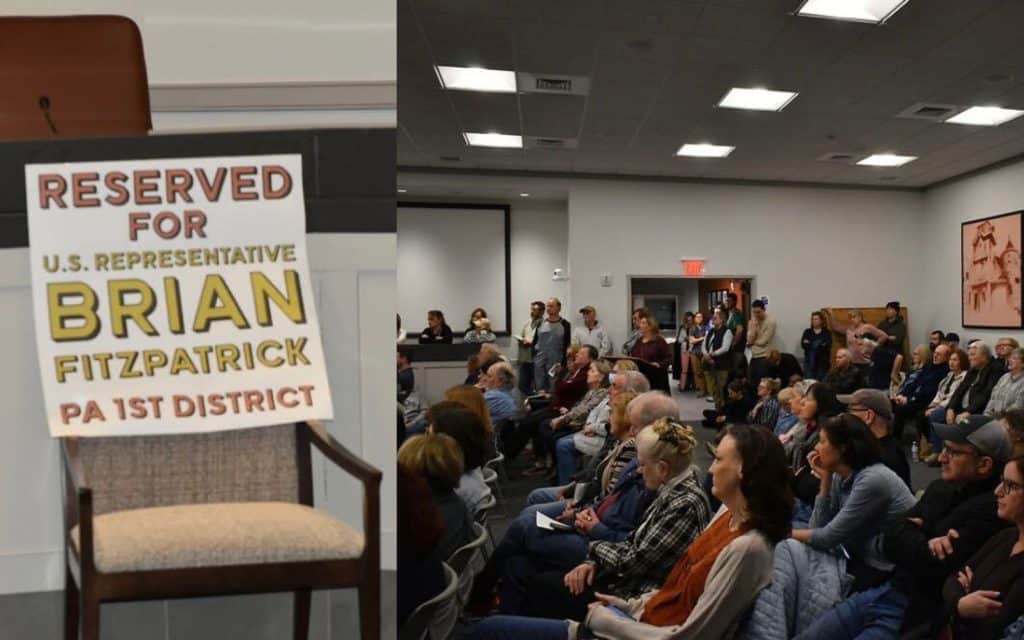
March 19, 2025 — hundreds of residents packed Doylestown Borough Hall for a town hall his constituents organized themselves, held during congressional district work time. Every chair and much of the floor was full.
One chair was left empty, with his name on it.
Local speakers went through what people had come to ask him about: cuts to Title One school funding, libraries and museums, immigration enforcement in the county, the SAVE Act's voter registration restrictions, cancelled farm programs, Medicaid, federal employees who had been fired, and threats to LGBTQ+ rights.
Nobody shouted anybody down. There was nobody there to shout down.
The part that doesn't add up
Fitzpatrick's whole political identity is that he is the reachable Republican — the one who works across the aisle, who talks to everyone, who co-chairs the caucus whose entire premise is talking to people you disagree with.
He is also, by his own website's record, a congressman who has announced one open town hall since 2017.
He will take a question from Margaret Brennan on a Sunday morning. He will not take one from a retiree in a high school gymnasium in Doylestown.
And the reason he gave for the difference, on that Sunday morning, was that the retiree is probably being paid.
What a town hall is for
There is nothing in the Constitution requiring a member of Congress to stand in a gym and get yelled at. It is not a legal duty.
It is, though, the one setting where anyone who shows up gets to ask, the follow-ups aren't controlled, and the person asking gets to decide what matters. A telephone town hall is a broadcast. A press hit is a broadcast. Only the room is a conversation.
Fitzpatrick represents one of the most closely divided districts in America. Those are precisely the constituents with the most to say to him, and they have been asking to say it in person for years.
Seven hundred letters, an empty chair, and one announced town hall in nine years.
Source
Chris Ullery, "Brian Fitzpatrick: 'dark money groups' turn town halls into 'circus;' no plans to hold one", Bucks County Courier Times, March 10, 2025; the town hall exchange is quoted from the CBS News Face the Nation transcript of March 9, 2025.