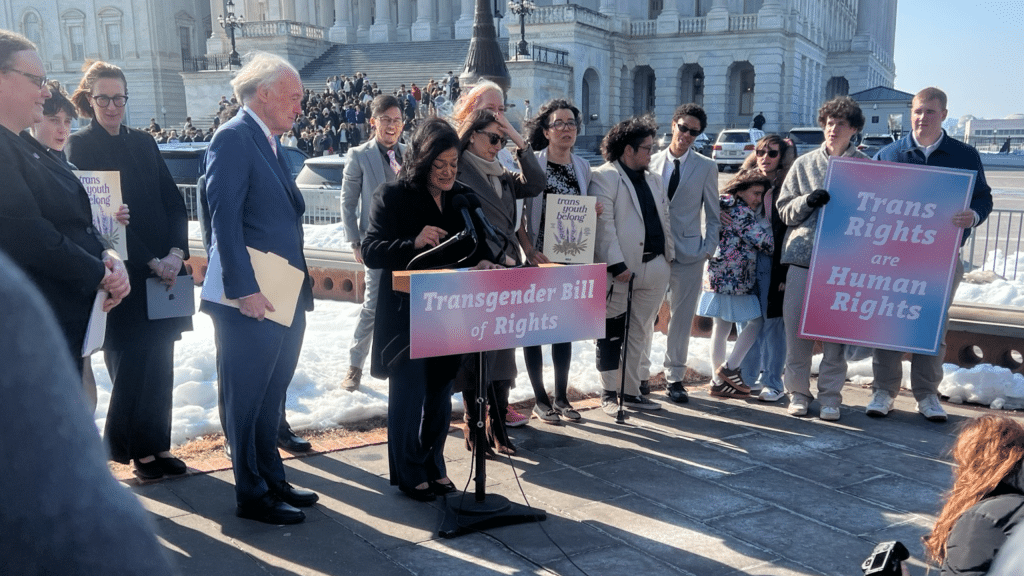
In mid-February 2026, three people from Ohio walked into a congressional office in Washington to lobby their congressman.
One was a father named Mike, a Navy veteran. One was his 17-year-old daughter Marigold, who is transgender. The third was Kaden Ames, 63, a transgender elder. They were in D.C. with the ACLU and Advocates for Trans Equality, lobbying for trans rights. On Marigold's list was the part of the 988 crisis line built for LGBTQ+ young people, which the federal government had shut off.
The office was David Joyce's.
Here is what happened, as The Buckeye Flame reported it: Joyce's staffer had a tablet and pen to take notes. Once he realized what the meeting was about, he put his phone on top of the tablet and leaned back. "You couldn't read anything from him," Ames said.
"Did he blink at all?" Ames asked afterward.
"I've had more engaging conversations with trees," Mike said.
"It felt like we had gotten nowhere," said Marigold.
Mike later learned the staffer was newly hired.
They weren't asking for much
The group also met with staff for three Minnesota lawmakers that day. Those staffers took notes and seemed familiar with the issues. When Marigold brought up the 988 cut, they looked surprised and thanked her for the reminder.
That's the whole comparison. Nobody in Joyce's office had to agree with them. Somebody had to write it down.
The service that got switched off
On July 17, 2025, the federal Substance Abuse and Mental Health Services Administration shut down the 988 Suicide & Crisis Lifeline's specialized services for LGBTQ+ young people. Callers under 25 could no longer press 3, text PRIDE, or use the online chat to reach a counselor trained to work with them.
Since the program launched in 2022, it had served roughly 1.5 million LGBTQ+ young people.
"This administration has made a dangerous decision to play politics with real young people's lives," said Jaymes Black, the Trevor Project's CEO.
This is not an abstraction to a 17-year-old girl who came to Washington to ask about it. It is a phone number that used to connect to somebody who understood her, and now doesn't.
Two House Republicans signed the bill to turn it back on. Joyce didn't.
In September 2025, Rep. Raja Krishnamoorthi introduced H.R. 5434, the 988 LGBTQ+ Youth Access Act. It directs the Department of Health and Human Services to restore the specialized service and to set aside at least 9 percent of 988 funding to keep it running.
Two Republicans joined as original cosponsors: Mike Lawler of New York and Brian Fitzpatrick of Pennsylvania.
"Nearly 1.3 million LGBTQ+ youth have already turned to the 988 Suicide & Crisis Lifeline's 'Press 3' option," Fitzpatrick said. "That tells us two things: the need is staggering, and the service is working."
The bill now has 166 cosponsors. Two of them are Republicans — still just Lawler and Fitzpatrick. David Joyce is not on the list.
He could be. There is no political cost he hasn't already paid.
He is exactly the Republican who could have said yes
Joyce has spent his career being described as one of the reasonable ones. He is one of the small group of House Republicans who voted for the Respect for Marriage Act — twice, including final passage on December 8, 2022, when the House sent the bill protecting same-sex marriage to the President's desk. We've written before about how rare that made him among Ohio Republicans.
So the constituents who showed up in February weren't picking a fight with a hardliner. They were doing the thing everyone tells people to do: find the Republican most likely to listen, and go make your case in person.
That's how the system is supposed to work. A father takes his kid to Washington. They sit in a chair across from a staffer. They make the case for kids like his daughter, and they ask their congressman to listen.
And the answer was a man leaning back in a chair, looking at his phone.
The pattern in his own district
This isn't the first time constituents have described Joyce's office as a place where nothing lands.
In spring 2025, people in Geauga County got so tired of not hearing back from his office that they organized their own town halls without him. What he offered instead was a telephone town hall that ran about 30 minutes.
It's the same complaint from a completely different set of people: we asked, and there was nobody there.
Joyce has represented Ohio's 14th District since 2013. In 13 years, a member of Congress builds an office culture — who gets a real meeting, who gets a newly hired staffer and a blank notepad. The people who travelled to Washington to make that case in person found out which one they were.
Source
"I've had more engaging conversations with trees": Trans Ohioans get a cold reception from Ohio US rep in D.C. trip — The Buckeye Flame, March 17, 2026.


