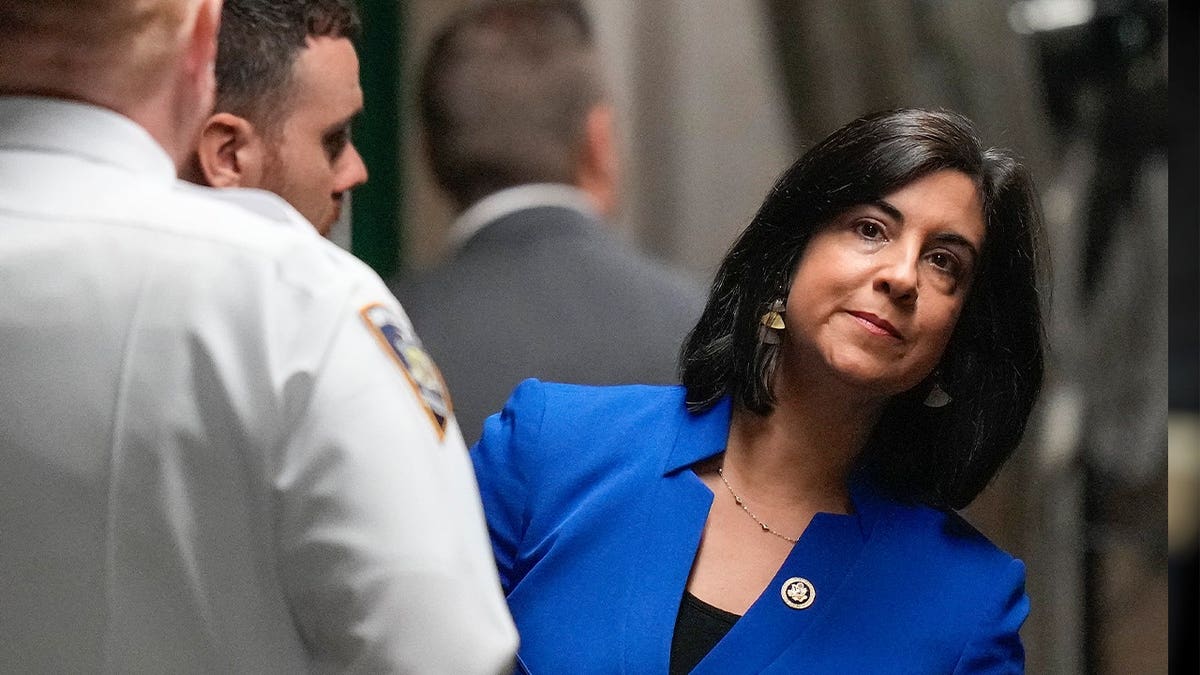
Nicole Malliotakis went to Fox News Digital last week with an argument that sounds like plain common sense.
New York City's mayor, she said, requires photo ID to use a city-run supermarket program, and more than one form of identification for a city snow-shoveling program — but his party will not require any ID to vote.
"Sadly, you see the hypocrisy when you see programs like Mayor Mamdani wanting to require photo ID to utilize a government-run supermarket or when he wanted you to use a photo ID, not just one, but multiple IDs for a snow shoveling program."
Her conclusion was that the Senate should pass the bill sitting in front of it. "We've passed it out of the House now four times and is up to the Senate to get the job done," she said. She added that "over 80% of America wants it," and that the only holdouts "are the Democrats who are in Congress right now."
Then she named the bill and described it in the same breath:
"If you want people to be confident in the outcome of the election, then we need to pass the Save America Act. We need to require voter ID."
That much is accurate. The bill does require voter ID. But requiring voter ID is one of two things it does, and she never mentioned the other one — which is the half that will cost people a registration.
Two halves, and she talked about one
The SAVE America Act is not last year's SAVE Act. It is a newer bill, and the House moved it by taking an unrelated Senate measure — a veterans bill numbered S. 1383 — and replacing its entire text with its own. As FactCheck.org put it when the Senate began debate, "Unlike last year's SAVE Act, the bill also would require voters to present photo identification before casting a vote, whether by mail or in person."
What came out of the House has two operating sections.
One is the photo ID requirement. An election official "may not provide a ballot" to a person voting in person "unless the individual presents to the official a valid physical photo identification." Someone voting by mail has to send a copy of one, or the last four digits of a Social Security number along with a sworn statement that they could not get a copy. Miss it at the polls and you cast a provisional ballot that does not count unless, within three days, you come back with the card or swear you have a religious objection to being photographed.
The list of cards that qualify is five items long: a state driver's license, a state ID card issued by a motor vehicle agency, a U.S. passport, a military ID, and a Tribal ID. Nothing a city issues is on it.
The other is the part she left out. Before anyone votes, they have to be registered, and this is where the bill does its real work. To register — or to change a registration you already have — you must hand over documents proving you are a citizen. FactCheck.org's summary is exact: the bill "would require people to present citizenship documents in person to election officials, even if they are registering by mail."
What counts as proof
The statute's list here is five items too, and only one of them is a single card an ordinary person is likely to be carrying:
- A REAL ID that states on its face that you are a citizen. Five states issue an "enhanced" license that does.
- A valid U.S. passport. About 53% of Americans have one.
- A military ID, together with a service record showing you were born in the United States.
- A government photo ID that shows a U.S. birthplace.
- Any other government photo ID — but only if handed over together with a certified birth certificate, a hospital record of birth, an adoption decree, a consular report of birth abroad, a naturalization certificate, or an American Indian Card.
So for almost everyone it comes down to a passport, or a driver's license and a birth certificate carried to a government office during business hours. A Social Security card will not do it. Neither will a utility bill, a benefits card, or the photo ID you would show at a city grocery counter.
We've written before about what that requirement does to people who cannot put their hands on the documents. The numbers behind it:
- The Bipartisan Policy Center, analyzing the 2024 Survey on the Performance of American Elections, found that 12% of registered voters have neither a passport nor a birth certificate paired with a government photo ID.
- A 2023 survey by the Brennan Center and other groups found that 21.3 million Americans of voting age, more than 9%, did not have easy access to citizenship documents — they could not quickly find them if they had to show them tomorrow.
- 84% of women who marry change their surname — as many as 69 million American women whose birth certificate no longer carries their legal name. The bill says nothing about marriage certificates or change-of-name papers.
And this does not stop at first-time registrants. Nobody has to re-register just because the law passed, but anyone who re-registers for an ordinary reason walks into it. The legal director of VoteRiders told FactCheck the statute "is drafted broadly enough to encompass all changes to registration." David Becker, of the nonpartisan Center for Election Innovation & Research, said proof would be needed "any time you conduct what we call a registration transaction, which usually comes from a life event, a move or a change of name."
Malliotakis represents Staten Island and part of southern Brooklyn. For anyone there who has married and changed her name, moved between boroughs, or never had a reason to hold a passport, that is an errand with original documents, in person, during the working day.
Her "over 80%" is close for one half and high for the bill
Her figure is roughly right about the popular part, and the polling shows exactly where the popularity stops.
A Harvard CAPS/Harris poll of 1,999 registered voters, conducted February 25 and 26, found 71% support for the SAVE America Act as the pollster described it. Taken apart, the pieces polled higher: voter ID at 81%, removing noncitizens from the rolls at 80%, proof of citizenship to register at 75%, and sharing voter rolls with the Department of Homeland Security at 61%. Gallup in October 2024 found 84% support for photo ID at the polling place and 83% for requiring people registering for the first time to prove citizenship. A Pew Research Center poll found 83% support for showing government-issued photo ID before voting.
So "over 80%" describes voter ID well. It overstates the bill.
More to the point, none of those questions is the bill. Gallup asked about first-time registrants; this bill reaches the woman who married last year and the family that moved across the borough line. No pollster has asked whether a citizen should have to carry a birth certificate to a government office to keep a registration she has had for thirty years.
Becker made the same point about how the question is put: "If you just ask the regular question in polls, do you support voter ID, you do see vast majorities of Americans say yes, including majorities of Democrats. If you ask people, should eligible voters without voter IDs be disenfranchised, you get very different responses." The Harvard poll tested that directly. Asked which mattered more, 54% chose doing everything possible to stop fraud and noncitizen voting, and 46% chose making sure eligible citizens are not denied the ability to vote.
Selling the whole bill on the half that polls at 81% is a choice. South Carolina's new senator made the same one when she compared this bill to showing a card to check out a library book. A card at a counter is the polling-place half. The registration half has no counterpart in any city program, library, or supermarket.
She voted for it. Here is the record.
The House has taken four votes on this bill and its predecessors.
- July 10, 2024 — H.R. 8281 passed 221 to 198. Malliotakis voted Aye.
- September 18, 2024 — a stopgap spending bill carrying the SAVE Act failed 202 to 220. Malliotakis is recorded as not voting.
- April 10, 2025 — H.R. 22 passed 220 to 208. Malliotakis voted Yea.
- February 11, 2026 — S. 1383, rewritten as the SAVE America Act, passed 218 to 213. Malliotakis voted Yea.
She told Fox the House has passed it four times. The House voted four times and passed it three. She was there for all three.
She is entitled to those votes. What she is not entitled to is describing the bill to constituents as a photo ID law and stopping there, when the rest of it is what they would meet at the registration desk.
What the Senate has actually done
Her charge is that the Senate is sitting on it. The Senate took it up. On March 17 it agreed to proceed by 51 to 48 and spent ten days on it. Then, on March 26, a cloture vote fell short, 53 to 47 — sixty are needed to break a filibuster. That is the last thing the Senate has done with the bill. It has never voted on whether to pass it.
The problem the bill claims to solve
Malliotakis's stated reason is confidence in election outcomes.
Noncitizen voting in federal elections is already a federal crime, and it is already almost nonexistent. When the Brennan Center surveyed election administrators who together tabulated 23.5 million votes in the 2016 election, those officials had referred roughly 30 suspected incidents of noncitizen voting for investigation — 0.0001 percent of ballots. In the study itself, forty of the forty-two jurisdictions reported no known incidents at all.
The bill would not remove a single illegal vote that isn't already illegal. It would add a documents requirement that falls on married women, seniors, renters who move, and people who work hourly shifts.
On confidence in elections, specifically
If Malliotakis's concern is that Americans trust election outcomes, there is a more direct place to look than voter registration paperwork.
On January 9, 2025 she became one of twelve members of Congress to sign a resolution expunging Donald Trump's impeachment for inciting the attack on the Capitol — an attack aimed at stopping the certification of an election. Twelve days later she went on CNN and said of those who assaulted police officers that day, "those do need to serve the time."
You cannot spend one week arguing that the 2020 result should never have been contested and the next arguing it should be erased from the record. Confidence in elections is not damaged by citizens registering to vote. It is damaged by elected officials who treat the outcome as negotiable when they lose.
Where constituents could ask her about this
They can't, in person. Staten Islanders have been showing up outside her district office on Mondays — including with cupcakes for Medicare and Medicaid's 61st birthday — and she still has not held a town hall. The Joint Economic Committee's district table puts 39,380 people in her district on track to lose Medicaid coverage from the budget bill she voted for.
A town hall is exactly where someone would get to ask the simple question: Congresswoman, I've been registered here for thirty years and I changed my name when I got married. What do I bring, and where do I bring it?
Her Fox News answer, which she gave to a national audience instead, was that citizens need to hold senators accountable.
The senators are not the ones who described it to New Yorkers as a photo ID law.
Sources
- Fox News, "New York City's lone Republican in Congress accuses Mamdani, Schumer of 'hypocrisy' in voter ID fight" by Robert McGreevy (August 14, 2026). Photo by Seth Wenig-Pool/Getty Images.
- FactCheck.org, "Q&A on the SAVE America Act" by Lori Robertson and D'Angelo Gore (March 18, 2026) — the source for the photo ID comparison, the in-person requirement, the document list, the Bipartisan Policy Center and Brennan Center figures, and the Harvard CAPS/Harris, Gallup and Pew polling.
- The text of the bill as it passed the House: S. 1383, Engrossed Amendment House, February 11, 2026.
- Center for American Progress, "The SAVE Act: Overview and Facts."
- Brennan Center for Justice, "Noncitizen Voting: The Missing Millions."
- Joint Economic Committee, "District-Level Impacts of Health Care Cuts."


