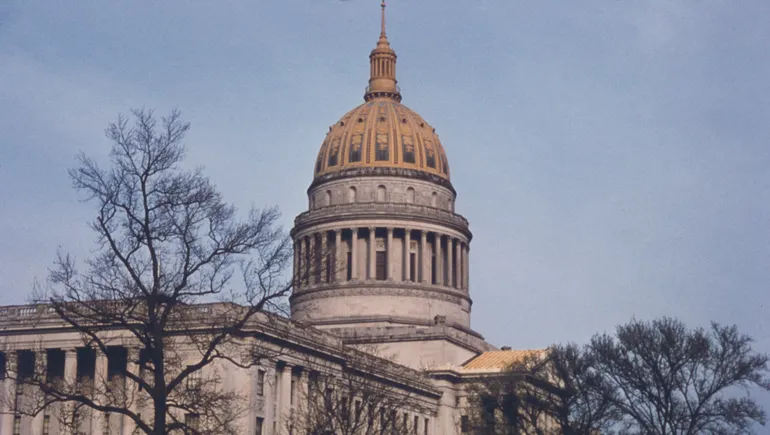
Before he was in Congress, Riley Moore was West Virginia's state treasurer. The treasurer's job is unglamorous: manage the state's cash, run its banking relationships, and get West Virginia the best terms it can when it borrows money.
Moore used it to run a political campaign against banks.
In July 2022 he published a "Restricted Financial Institution List" barring five of the largest financial firms in the country from new state banking business: BlackRock, Goldman Sachs, JPMorgan Chase, Morgan Stanley, and Wells Fargo. Their offense, as Reuters reported at the time, was being deemed to "boycott" fossil fuel companies — which in practice meant weighing climate risk when deciding where to put money.
Then he did it again. In February 2024, Moore sent notices to six more banks — BMO, Citibank, Fifth Third, Northern Trust, TD Bank, and HSBC — warning they were headed for the same list.
What he said he was doing
Moore's framing was that he was protecting West Virginia's industries from coordinated financial pressure. Here is how he put it in 2024:
"While we have been effective in our fight against ESG activism, we must remain vigilant to ensure we do not entrust state funds to banks that are engaged in coordinated political efforts to destroy our state's critical industries."
He wanted the banks, in his words, "to return to fairer, more objective treatment of our coal, oil and natural gas industries."
That's a coherent political position. The question is who pays for it.
What it costs
When a state tells the biggest underwriters in the country they can't bid on its business, fewer firms compete to handle its bonds. Fewer bidders means worse pricing. Worse pricing on borrowing means higher interest — and interest on state debt is paid by taxpayers, out of the same budget that funds schools, roads, and water systems.
This is not a theoretical objection. Somebody has put a number on it.
The consulting firm Econsult Solutions, engaged by the climate group the Sunrise Project, studied Texas, which passed similar laws, and put the extra interest on the bonds Texas issued in one year at between $303 million and $532 million — spread over the life of those bonds. Applying the same model to West Virginia, Econsult estimated that if Senate Bill 262 worked the way the Texas laws did, the extra interest on West Virginia's own bonds from that year would run $9 million to $29 million.
Nine to twenty-nine million dollars in extra interest, on a single year's borrowing. In one of the smallest and poorest states in the country.
For comparison: in June 2026, Moore stood in front of the House Appropriations Committee holding a jar of brown tap water from a McDowell County home and asked for $50 million to fix southern West Virginia's drinking water. The committee said no.
The high end of what his bank blacklist may have added to the interest on one year of West Virginia's borrowing is more than half of the water money he couldn't get.
Who this was actually for
Moore's line is that the banks were attacking West Virginia's industries. Look at whose money moved when he ran for Congress.
Three outside groups spent more than $1 million electing him — led by the cryptocurrency industry's super PAC at $726,377 and the Koch network's at $265,673, against the $924,000 he raised from PACs directly. His direct donors include the corporate PACs of Marathon Petroleum, Valero Energy and the steelmaker Cleveland-Cliffs. Only 9% of his money came from small grassroots donors; he ranks #344 out of 440 House members in grassroots funding.
Whatever the five banks on that list were doing to West Virginia's coal industry, blacklisting them did not put a miner back to work or keep a plant open. What it did do was give a state treasurer a national fight to be seen having — and, as it turned out, a profile that converted into more than $1 million of outside money when he ran for Congress two years later.
Moore carried the same approach into Congress, where he now has a 0% score from the League of Conservation Voters for 2025. A perfect zero in his first year.
The trade he made
West Virginia is a state that needs cheap money. It has old water systems, old bridges, and a tax base that can't absorb a bad borrowing year the way Texas can.
Its treasurer decided the state should pay more to borrow, in order to make a point about how five banks in New York think about climate risk.
He got the point made, and the profile that came with it. The bill for the point is in the interest line of West Virginia's bond payments, where nobody has to look at it.
Sources
Lamar Johnson, "West Virginia warns 6 banks they're headed for restricted list over fossil fuel stances", ESG Dive, March 1, 2024; and "West Virginia bars five financial firms for deemed fossil fuel 'boycotts'", Reuters, July 28, 2022.


