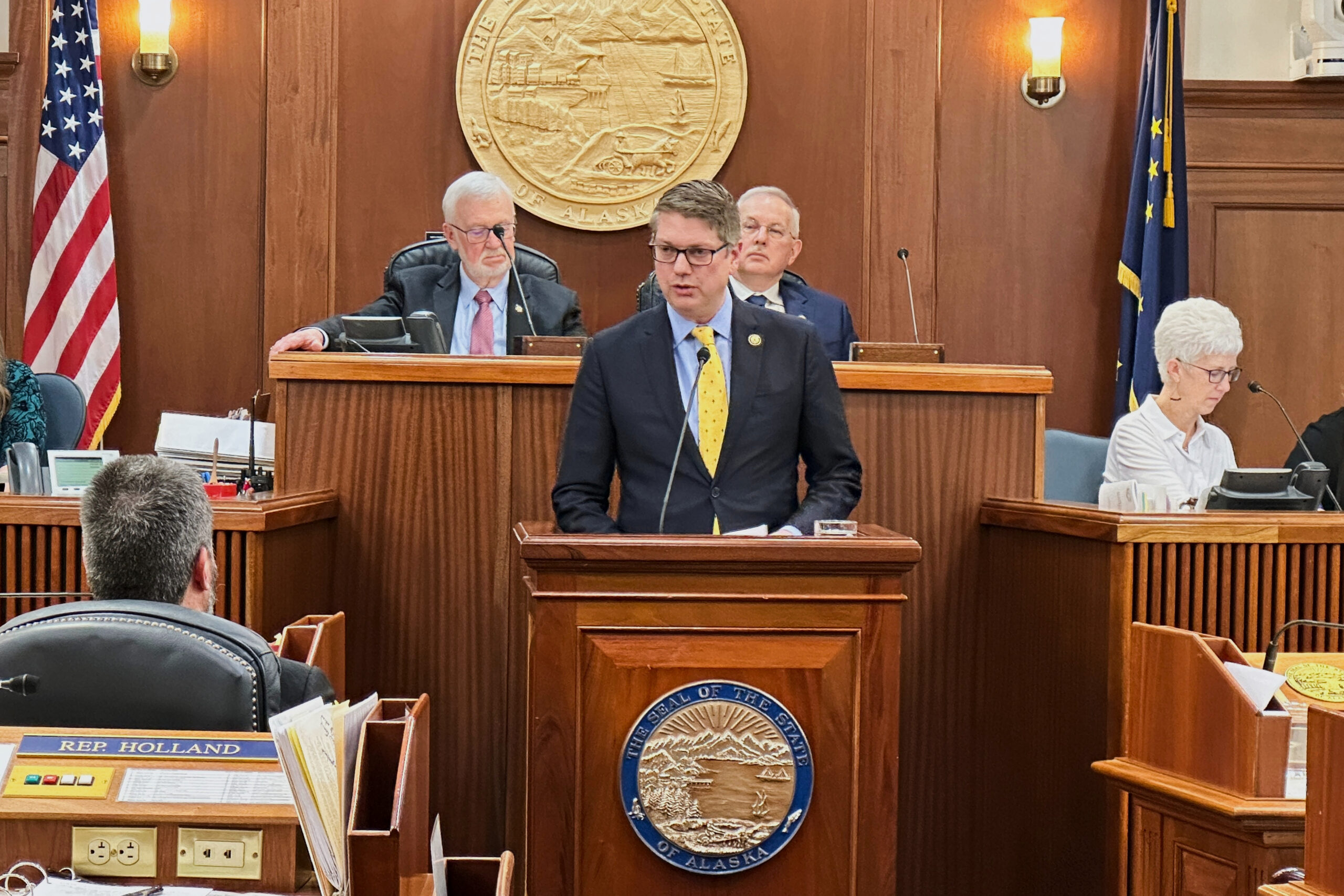
On June 18, 2026, Derek Schmidt put his name on a bill to keep USDA offices from closing.
It's called the USDA Field Office Stability Act. Democrat Sharice Davids of Kansas wrote it, and Schmidt signed on as an original cosponsor the day she filed it, which is genuinely unusual and genuinely useful. It would bar the Agriculture Department from shutting or moving the county offices that farmers actually walk into — the Farm Service Agency, the Natural Resources Conservation Service, Rural Development — unless another office sits within 20 miles. It would force USDA to keep enough people on staff to keep the doors open during business hours.
Here is Schmidt explaining why it's needed:
"Many small offices are staffed by only one or two people, which means a reduction in staffing can leave the office unable to function."
He's right. That is exactly what happened. The question worth asking is who did it.
Kansas lost about a third of its USDA workforce
The numbers in Schmidt's own bill announcement are brutal. Kansas has lost more than 500 USDA employees — roughly 32 percent of its USDA workforce, the largest percentage drop in the region. Nationally, more than 24,000 USDA employees left the department after January 2025, a nearly 27 percent reduction between September 2024 and December 2025.
That did not happen by accident, and it did not happen because of some vague thing called "Washington."
The National Sustainable Agriculture Coalition tracked the departures using federal personnel data. It found about 20,000 USDA employees gone between January 2025 and January 2026, and attributed the majority of them — around 15,000 — to the Deferred Resignation Program, the buyout push run by Elon Musk's Department of Government Efficiency. Kansas shows up in that data at 559 employees lost. The number of USDA staff with more than ten years of service fell by nearly 7,000 over that year, from 45,247 to 38,291. Investigate Midwest, reporting on a separate NSAC analysis built from a Freedom of Information Act request, found the same cause: the losses came primarily after DOGE's early-retirement and deferred-resignation offers.
So: DOGE emptied the offices. Now let's look at what Derek Schmidt was saying while it was happening.
"Maturing"
In April 2025 — the month USDA gave employees one week to decide on a second round of buyouts — Schmidt went on KVOE radio in Emporia and was asked about DOGE. He said the approach was "maturing" and would become more "predictable" over time.
Not "this is going too fast." Not "somebody should check what this does to farm country." Maturing.
Seven weeks later, on June 12, 2025, Schmidt voted to make a big chunk of DOGE's work permanent. He put out a press release taking credit for it, naming "the Department of Government Efficiency," and saying he hoped the $9.4 billion clawback of money Congress had already approved would prove "a watershed."
DOGE itself shut down on July 4, 2026, with no final report and nobody willing to own the wreckage. The wreckage stayed.
Ten months later, the countryside called
By April 2026, the empty offices were a problem Schmidt could not talk around.
On April 23 he signed onto a letter with 14 other members of Congress asking USDA to fix the staffing shortages. His own press release describing that letter lays out the damage in plain language: constituents were reporting "delays in application processing, payments, and contract certifications," with conservation programs and the FSA farm loan program hit hardest. If it kept up, the letter warned, the disruption could spread across every USDA program in that division.
Talking to KWCH that evening, Schmidt put it this way:
"Sometimes decisions get made in Washington that look good on paper, but don't make a lot of sense out in the countryside in Kansas."
Read that again. Schmidt is Washington. He has been since January 2025. He was in the room, he had a vote, and when the decision was in front of him he hoped out loud it was a watershed.
The Kansas Farmers Union's executive director, Nick Levendofsky, told the same station that some parts of the state now have no USDA staff at all, so producers either drive further or give up on benefits they've already earned. On KZRG in May, Schmidt described the mechanics himself: "In a lot of these small counties, there are literally one or two people. That's the entire staff of the USDA local office. Well, if you cut one person out of it or two, you're literally left with an office that can't function." And: "In some cases, there's nobody there to do the work."
He is describing, accurately and with real feeling, the wreckage of a project he cheered.
The same offices Kansas farmers need because of his other votes
The timing is its own indictment. Kansas farmers need those FSA counters more than usual right now, and the reason is the trade war.
Schmidt voted twice in March 2025, and again that September, to keep the House from even considering a repeal of Trump's tariffs — one sentence tucked into a procedural motion, three times over. As of that October, U.S. soybean sales to China for the year stood at zero. Moody's put the Kansas economy in recession, driven largely by collapsing farm exports.
The federal answer to that has been bailout money. Bailout money is applied for, processed, and certified at exactly the county offices that no longer have anybody sitting in them.
We've seen this movie
This is now a recognizable genre. A Republican cheers the cuts, the cuts land on people back home, and the Republican writes letters.
New York's Andrew Garbarino did it with the 9/11 responders' health program — four rounds of DOGE cuts, four rounds of letters to undo them, and then a vote to make the rest of DOGE's cuts permanent. Kentucky's Andy Barr told a Lexington business crowd "don't worry about DOGE", passing along promises from Elon Musk that turned out to be wrong one after another.
The bipartisan USDA bill is a good bill. Kansas Farmers Union president Donn Teske thanked Schmidt and Davids for it, and he was right to. But it is a patch on a hole Schmidt helped cut, and it does not bring back 559 people or their combined decades of knowing which form a Kansas rancher needs.
If your congressman wanted to tell you about that, there'd be a room and a microphone somewhere. Schmidt's version of a town hall is a phone call, on a topic he picks, where the announcement said up front that he and his co-host would "not give individual tax advice." When KCUR invited all nine members of Congress from the Kansas City metro to take live questions from constituents about DOGE and tariffs in 2025, Schmidt's office was among those that never responded to the invitation.
More than 1,000 people took part anyway, in the room and on the livestream. They had questions about this exact thing.
Source
Davids, Schmidt introduce bipartisan bill to keep USDA offices open for Kansas farmers and ranchers — KWCH, June 18, 2026, and Kansas congressman urges USDA to address staffing shortages at local offices — KWCH, April 23, 2026.